
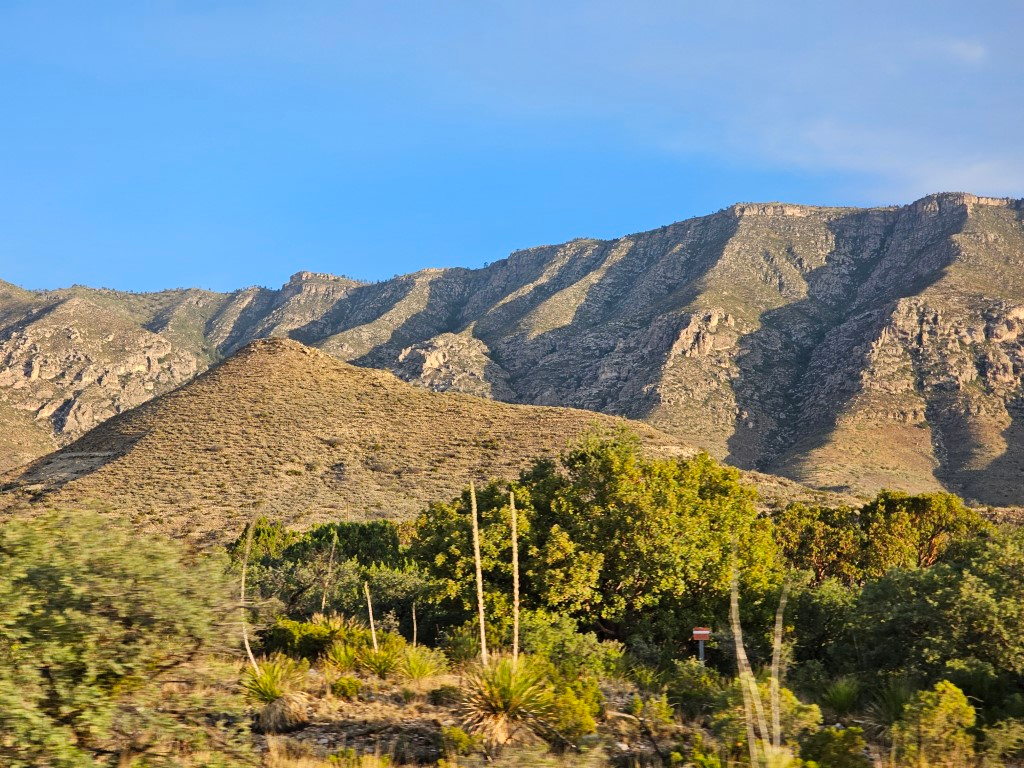
If you’ve never heard of Guadalupe Mountains National Park, don’t worry—you’re not alone. Officially established in 1972, this lesser-known park protects more than 86,000 acres of the Chihuahuan Desert in far west Texas, just south of the New Mexico state line.
Table of Contents
About the Park
The park’s dramatic namesakes rise abruptly from the desert floor, with Guadalupe Peak topping out at 8,751 feet, making it the tallest point in Texas. Beneath those rugged peaks lie ancient fossilized reefs—remnants of a prehistoric sea—one of the main reasons this area earned national park status in the first place.
Full Disclosure
We spent about half a day in Guadalupe Mountains, so much of what follows is based on information from the National Park Service rather than firsthand experience.
To be completely honest, we left feeling a bit underwhelmed. Much of the flora and terrain along the Guadalupe Peak trail felt similar to hikes near our home, which may have influenced our impressions. On top of that, unexpected health issues LeAnne experienced on the trail—combined with some less-than-ideal planning—forced us to turn around about a mile from the summit (a first for us).
All that to say: we didn’t explore this park in depth. If fossils, geology, and vast desert landscapes are your thing, this park may absolutely win you over—even if it didn’t fully do that for us.

Things to Do
Since we only did part of Guadalupe Peak and the Pine Springs Visitor Center, this section is largely curated from the NP website to provide you with more resources.
Visitor Centers
- Pine Springs Visitor Center is the main hub, featuring a small museum, park store, and a short narrated slideshow about the park.
- McKittrick Canyon and Dog Canyon each have small contact stations that are staffed sporadically.
Hiking
Hiking is the main attraction here, and preparation is key. Do not underestimate the need for water, calories, and sun protection. Summer heat can be extreme, and strong winds are common at higher elevations year-round.

Popular hikes include:
- Guadalupe Peak Trail
8.4 miles | Strenuous
Over 3,000 feet of elevation gain and typically takes 6–8 hours. The reward? Sweeping views from the highest point in Texas. - McKittrick Canyon
Varies- full trail is 21.6 miles | Strenuous
Offers multiple trail options of varying lengths and is supposed to be the place to visit in fall when the maples put on a colorful show. - Devil’s Hall
4.2 miles | Moderate to strenuous
Much of the trail follows a wash, making footing unstable. Expect some rock scrambling near the end to reach the “hall.”
Salt Basin Dunes
Tucked into the southwest corner of Guadalupe Mountains National Park—about 1.5 hours from Pine Springs—these gypsum dunes are reached via a 0.75-mile (each way) trail. While we didn’t feel the long drive was worth it for our schedule, they could be a great stop if you’re already approaching from the south.
Frijole Ranch
This historic ranch has been converted into a small museum highlighting human history in the area and is a quick, worthwhile stop.
Still To Do
If we return, it won’t be until Williams Ranch Road reopens. Closed since severe flood damage in 2021, this rugged 4WD road requires high clearance and looks like exactly our kind of adventure. Fingers crossed it reopens someday.
How Much Time Do I Need?
This is a tough one.If you’re not planning to tackle longer hikes, there isn’t a huge variety of activities. Your ideal visit length also depends heavily on the time of year. Before going, we recommend spending time on the NPS website to research trails, check alerts, and confirm current conditions.

Tips & Tricks
- Double-check the time. The park is located in Mountain Time Zone. Most of the nearby cellular towers are in Central Time Zone, so smartphones will often be incorrect.
- Fuel up. There is no gas in the park. The nearest station is 35 miles away, so plan ahead.
- Bring food. There are a few sundries in the Visitor Center, but no grocery stores or restaurants, so bring food with you.
- Consider leaving Fido at home. Pets are prohibited on most trails, and weather can be unpredictable. Both you and Fido will probably enjoy it more if the pets skip this adventure.
Did You Know?
- At 8,751 feet, Guadalupe Peak is known as “The Top of Texas.”
- Eight of the ten tallest peaks in Texas are located in the Guadalupe Mountains.
- The Guadalupe Mountains are considered a “sky island,” with desert lowlands and alpine environments at higher elevations.
- The park contains four distinct ecosystems: desert, canyon, woodland, and alpine.
- Wind gusts at the peaks can reach 80 mph, occasionally closing trails.
- The Butterfield Overland Stage Line, the first transcontinental mail route, once passed through this area.
Nearby Attractions
- Carlsbad Caverns National Park – about 45 minutes north
- Sitting Bull Falls – approximately 1.5 hours north
Camping
Since we were also visiting Carlsbad Caverns National Park, we based ourselves nearby to minimize driving. We stayed at Whites City RV Park, about 45 minutes north of Guadalupe Mountains National Park, solely for its proximity and reliable electricity—crucial during a June visit (yes, it was hot, and yes, it rained).
We stayed in the overflow area, which is essentially a gravel lot next to the store. Reservations require calling ahead, and AAA and AARP discounts are available. Check-in happens at the store before reaching the campground, and sites are not pre-assigned, so pull off to the left as soon as you turn onto Carlsbad Cavern Highway.
There are also:
- Two primitive campgrounds within the park
- One campground designated for equestrian use
- Several nearby boondocking options for those who prefer dispersed camping
Final Thoughts
For us, Guadalupe Mountains National Park was a “check it off the list” stop. That said, we don’t feel like we gave the park a fair shake due to our short visit, limited planning, and unexpected health challenges.
If you love geology, fossils, and expansive desert landscapes, this park may resonate with you far more than it did with us—and we can absolutely see why.
Have you visited Guadalupe Mountains National Park? We’d love to hear about your experience.
